
David Idstein, Director of Character and Leadership, in collaboration with James Thomsen, Boys to Men coordinator.
As our Year 10 2026 cohort commences their Boys to Men program this week, it is timely to reflect on the meaning, purpose and research behind this important event in our School Calendar.
The Boys to Men program was established by former Headmaster Dr Tim Hawkes, who had a vision for supporting young men as they navigate the challenges of early adulthood. He recognised that the movement from adolescence into young adulthood should be acknowledged and celebrated by our community in a positive way.
A few years later, Dr Arne Rubinstein presented to The King’s School staff at Tudor House on his work around rites of passage and their role in helping young people develop into healthy young adults. Dr Rubinstein has worked as a General Practitioner specialising in Adolescent Health and Emergency Medicine and is now CEO and co-founder of The Rites of Passage Institute.
In his book The Making of Men, Dr Rubinstein reflects on his time as both an emergency doctor and a youth mentor. He observed that many young men were engaging in significant risk-taking behaviours resulting in emergency department presentations at a disproportionate rate. He witnessed the devastating consequences of teenage boys car surfing, train surfing, taking drugs, drinking alcohol to excess and engaging in aggressive and violent behaviour.
Dr Rubinstein’s hypothesis? These teens were looking for ways to prove themselves. It was a subconscious demonstration that they were ready for the challenges and responsibilities of adulthood. They wanted to impress their mates, and maybe even the adults in their lives. Beneath the risk-taking was a desire to be seen as young men.
In the absence of healthy and structured rites of passage, young men will often create their own. This can manifest as unnecessary and extreme risk-taking, dangerous behaviour or seeking acceptance through peers rather than trusted adults.
Dr Rubinstein observes that through a desire to keep our young people safe and always within reach, we have removed opportunities for honourable rites of passage. We have forgotten many of the traditional events that once marked the journey into adulthood in a positive and constructive way.
For thousands of years, cultures across the world recognised that becoming an adult was not determined by age alone. Communities intentionally created experiences that challenged young people, surrounded them with mentors and publicly acknowledged their growing responsibilities. Importantly, these rites of passage involved a physical removal from the normal routine and environment and a significant challenge. The rite of passage was marked and celebrated; for example, the Land Divers of Pentecost Island and the bullet ant gloves of the Satere-Mawe people of Brazil. To some extent, we have lost some of these opportunities for our young men to show what they are truly capable of and to be acknowledged into young adulthood.
Dr Rubinstein’s research identified several common elements that appear in rites of passage across cultures throughout history. These include separation, challenge, mentoring, reflection, and finally, return and honouring. The challenge itself is important, but it is not the whole point. A rite of passage ultimately helps a young person answer deeper questions: Who am I becoming? Who do I want to be? Who do I look up to?
Importantly, Dr Rubinstein also reminds us that greater freedoms and privileges must be accompanied by increased responsibility and can form a good framework for those difficult discussions with teenagers.
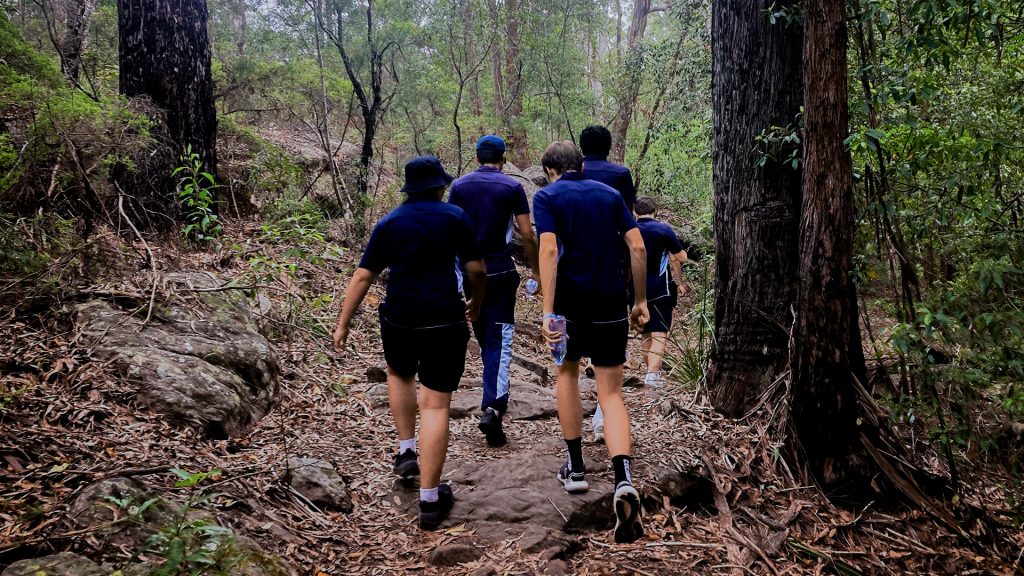
Viewed through this lens, The King’s School’s Boys to Men program becomes much more than an end-of-year activity. For two weeks, our Year 10 students step away from their normal academic routines, creating a clear separation from the familiar structure of school life. Throughout the program, they participate in activities that provide challenge, encourage reflection and invite them to think carefully about the type of young men they aspire to become. They serve others and have experiences that develop resilience, gratitude and self-awareness. They also participate in mature conversations about character, relationships and the impact of drugs and alcohol.
Two of the defining elements are the urban walk facilitated by the Rough Edges Café in Darlinghurst and the Lake Parramatta walk. The Lake Parramatta walk leads into the Father and Son Dinner. There, we come together to honour our young men and celebrate what they have achieved in the Boys to Men program. Fathers or significant mentors gather with the boys to acknowledge an important transition and to reflect on the responsibilities and opportunities that lie ahead.
The Boys to Men program and dinner reminds our boys that becoming a young man is not something that happens alone, it occurs within relationships. Families, mentors, teachers, friends and communities all play a role in helping young men navigate the journey.
As our Year 10s undertake the Boys to Men program, we encourage all parents to reflect on the milestones your sons have achieved over the year and celebrate it as a family. This might include a first cadet camp, moving into a senior house, an improved effort rating, achieving the silver Duke of Edinburgh award, a first performance on stage or commencing year 12 studies. As part of a celebratory meal, ask him about his goals, aspirations and important milestones he is looking forward to.
As we approach the end of the year, we encourage you to identify a rite of passage with your son and discuss it with the family. Maybe even discuss it with him while enjoying a shared pursuit. Go for a bush walk, go fishing, play pickleball, or a game of chess or golf. Boys often talk more when they are walking side by side or engaged in something meaningful.