

in detail:
Our history

William Broughton, founder of The King’s School:
“The education received in The King’s School is not for the exclusive benefit of those upon whom it is bestowed, but for that of the entire community.
Those educated at The King’s School should enjoy those advantages of liberal education which can alone expand and invigorate their understandings in the degree which their rank and employment will call for, and give them those enlarged and liberal views of morals and the science of government, those sentiments of independence, and that fixed impression in favour of revealed religion and correct representation of its doctrine, which afford in any country the surest guarantee that its affairs will be well and honestly administered.
We must beware the form of education where the learner, being enabled to make a display of information, is elevated in his opinion to his own powers. Experience proves persons having their memories cultivated at the expense of judgment are prone to contravene all established opinions, to despise the authority of all former times, and to decide without hesitation upon points which have exercised for Ages the minds of the most reflective men.”
A summary timeline
Foundation of the School
Moving and fever
Temporary closure
Re-opening, Cadet Corps and Old Boys' Union
Prep School and the House system
Chapel extension and Centenary
Growth, Tudor House, Relocation to Gowan Brae
Student numbers had never been as high and new subjects were introduced, particularly in the arts. It became obvious that the school would have to move if it was to continue to grow. A generous benefaction enabled the School to relocate to “Gowan Brae” in North Parramatta.
Year 12, Curriculum changes and focus on excellence
20th Headmaster
The School Arms
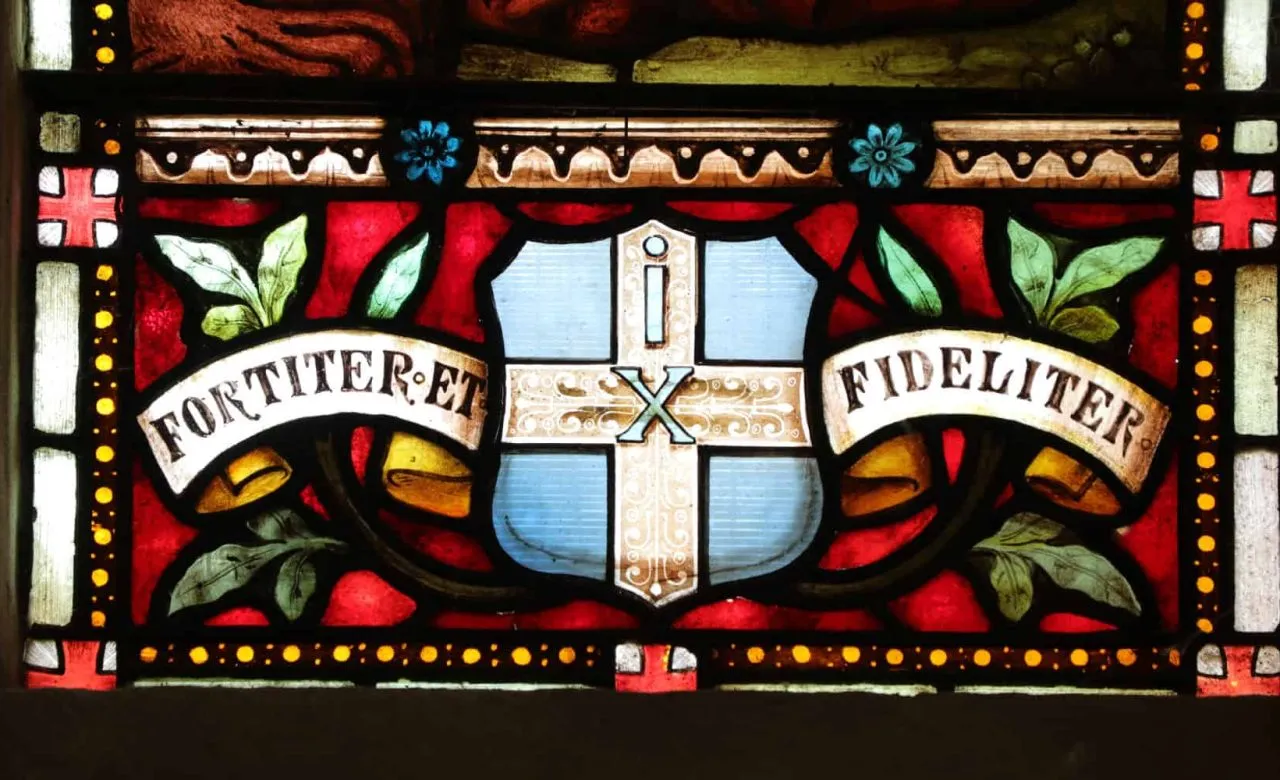
Over time, the School Arms has been modified and in its current form reflects the School’s heritage and Christian traditions. The adoption of the Arms of King’s School Canterbury (A below) took place during the Headmastership of the Reverend F Armitage (1855-1862) and may be seen stamped on the cover of prize books awarded to students of his time. The Arms with the additions of the inscribed scrolls (B) seems to have made their first appearance on the cover of the first edition of The King’s School Magazine in 1887 and on the metal badge worn on the kepi (cap) by the students in the School photograph that same year.
The form C below, used now on all School publications, lapel badges and the Cadet Corps slouch hat, originates from 1896 when the motto “Fortiter et Fideliter” (bravely and faithfully) was added to the Arms by Headmaster Reverend AH Champion (1895-1906).
The alteration of the date of the School’s foundation from 1832 to 1831 was due to Mr JAI Perry, the Honorary Secretary of the Council who, after researching the School’s early history, confirmed the School’s foundation date to be 1831. This change of date was approved by Council in 1913.
The ix in the centre of the shield represents the first letter of each of the Greek words for Jesus Christ. The colours on the Arms are sky blue and white, with blue representing the sky and white purity.

The School Crest
The origin of the Lover’s Knot, a symbol for St Valentine, is not clear, however, it was possibly adopted to celebrate WG Broughton’s consecration as Bishop of Australia, which took place in London on St Valentine’s Eve, 13 February 1832.

Long before the School adopted the Arms, the crown was used in association with The King’s School. This association continues today, particularly as a symbol when promoting the School, as it did when it first appeared on an advertisement for a School concert in the Sydney Herald in 1836. Headmaster Reverend George Fairfowl Macarthur (1868-86) adopted it as the image for the buttons of the Cadet uniform, now the grey jacket, and in 1893 the Sports’ Club approved its use as the image for the hat band on the Akubra accompanying the plain clothes suit. This was to replace the pale blue and white striped hat band which, made of silk, faded too quickly. Designed by WS Corr, the crown was worked in light blue on a black band with the initials “TKS” embroidered in a scroll below. The most significant use of the crown today, however, is that they are worn by the School Captain, one on each lapel of his jacket, as a symbol of leadership at The King’s School.

On 13 February 1834, the founder of our School outlined the aims of the School. He said:
“The education received in The King’s School is not for the exclusive benefit of those upon whom it is bestowed, but for that of the entire community. Those educated at The King’s School should enjoy those advantages of liberal education which can alone expand and invigorate their understandings in the degree which their rank and employment will call for, and give them those enlarged and liberal views of morals and the science of government, those sentiments of independence, and that fixed impression in favour of revealed religion and correct representation of its doctrine, which afford in any country the surest guarantee that its affairs will be well and honestly administered. We must beware the form of education where the learner, being enabled to make a display of information, is elevated in his opinion to his own powers. Experience proves persons having their memories cultivated at the expense of judgment are prone to contravene all established opinions, to despise the authority of all former times, and to decide without hesitation upon points which have exercised for Ages the minds of the most reflective men.” Rev PS Waddy, Headmaster 1907-1916, Old Boy 1893.
On 25 January 1830, the Venerable Archdeacon Broughton’s plan for the formation of Grammar Schools in New South Wales was laid before Governor Darling. In clause four of that plan it was proposed “that these Schools shall be of Royal Foundation, under the patronage and sanction of His Most Excellent Majesty, King George IV, and his successors upon the Throne of England; and shall, in consideration hereof, be termed The King’s Schools’’. When the royal patronage and sanction were ultimately obtained in 1831, King William IV was on the Throne of England. Two schools opened in 1832; the one in Pitt Street, under the Reverend G Innes, started in January. It closed when he died eight months later. The other opened at Parramatta on Monday, 13 February 1832, in rented premises in George Street, the two storey house being later named ‘Harrisford’. This house was purchased in 1980 by The King’s School Old Boys’ Union and restored as their gift to commemorate the School’s sesquicentenary.
The Reverend Robert Forrest, an Englishman, was appointed Headmaster in May 1831. On opening day, in 1832, there were three pupils, Ebenezer and James Orr and James Staff. All were under ten years old. By 2 April 1832 there were sixteen pupils only, but the Headmaster was expecting more. None were boarders.
The inducement offered to Robert Forrest to bring him to New South Wales was not very alluring. His salary was fixed at £100 per annum, in return for which he was required to act as an assistant Chaplain in the Town of Parramatta. He was promised a schoolroom, a house and a moderate allowance of land. His main source of income was to come from the fees which his pupils paid. The fee for boarders was fixed at £28 a year and for day boys at £8 per year. In addition to the worry of collecting these fees, the Headmaster had to maintain his boarders from them, and also, pay the salaries of his assistants, who were to receive £4 a year for each boy taught by them.
In January 1836, the School moved into its new premises, both land and building being supplied by the New South Wales government. Forrest resigned due to ill-health in June 1839. His brother-in-law, the Reverend John Troughton, was placed in charge of the School’s boarders, while the Reverend William Clarke was appointed Headmaster. Clarke was to become a famous geologist and as an old College friend of Broughton, was his first appointment, Forrest being appointed by Goderich. The Reverend WW Simpson, first cousin to Sir James Simpson, discoverer of chloroform, succeeded Clarke in January 1841. In 1843, the School had an enrolment of seventy, but an epidemic of scarlet fever, (Simpson and his wife also caught the disease), forced Simpson to resign and declare himself bankrupt, for most of his income depended on school fees. His replacement, the Reverend James Walker was a botanist of note and a famous classical scholar. Ill health forced him to resign in December 1847.
The hours of work, at School, for a boy in the early days, were seven school hours per day in summer and six a day in winter. There were two holidays every year, (beside Church holidays): a mid-winter vacation from 15 June to 15 July, and a mid-summer vacation from Christmas eve to the end of January.
Robert Forrest returned in 1848 to a school numbering 60 boys, but in September 1853 ill-health again forced his resignation. His school had grown to seventy boarders and twenty-nine day-boys. The Reverend Henry Bobart, incumbent of St John’s Parramatta, was appointed Acting Headmaster, but he died at the School in July 1854, and Archdeacon Cowper, the Administrator of the Diocese, asked the Headmaster of St James’ Grammar School, the Reverend Thomas Druitt, to take over the School. Military drill was included as a school subject by April 1855; Mr W Bamford, as part of his duties, was responsible for this subject. Druitt thought his appointment was a permanent position and the arrival of the Reverend F Armitage in January 1855, to take over as Headmaster, saw Druitt refuse to stand down until Bishop Barker arrived in New South Wales in May 1855.
Armitage, whose income was not dependent on school fees, as he had private means derived from coal mines in England, paid for several building improvements himself. Numbers soon increased to one hundred and fifty boarders and forty-two day-boys, the overflow of boarders being accommodated in the home of an assistant master, Mr HS Hawkins, in Ross Street. During this period, the first matrons – Palmer and Wilson – were appointed. In 1859, Armitage adopted School Arms. Because of the then current erroneous assumption that the School was named after the King’s School, Canterbury, he chose the coat of arms of that school, a school which inherited the oldest tradition of education in England, dating to St Augustine. This School was also the school attended by Bishop Broughton.
Mr L Trollope was appointed Acting Headmaster, while the Reverend F Armitage was on leave. He closed the School in June 1864, when the schoolroom roof fell in following a week of heavy rain.
Bishop Barker, who arrived in Australia to succeed Bishop Broughton in May 1855, initiated a drive to re-open The King’s School. In June 1868, the Reverend G F Macarthur agreed to accept the Headmastership, provided that he should immediately be appointed Headmaster of The King’s School in Macquarie Fields, for he was Headmaster of St Mark’s Collegiate School there. Macarthur was a grand-nephew of John Macarthur and a grandson of Governor King, the third Governor of New South Wales. He was also the first boy enrolled at the School, an asthma attack causing his absence on the first day.
When the School re-opened in 1869, the premises were in a good state of repair due to generous help from Old Boys and friends.
In 1886 Macarthur was succeeded by the Reverend A St John Gray. His short term of office saw the first portion of the Chapel built. Our first gymnasium, a cottage hospital and a School library were also established. The monitorial system was introduced by St John Gray, and the first issue of the School Magazine appeared in June 1887.
Gray resigned due to his wife’s ill-health, leaving his successor, Dr E Harris, a thriving school of one hundred and thirty-eight boarders and 34 day boys.
The School, at this time, was a two-storey building. On the ground floor were two classrooms, Upper and Lower School; between these was a passageway leading to the porch. The first floor was dormitory space.
The Reverend Dr Harris was the first Headmaster to suggest moving the School, which from 1869 into the 1920s was comprised mainly of graziers’ sons, sent to become gentlemen and then return to the land. That scholarship existed, however, is evidenced by many boys of the period who achieved high scholastic successes at the University.
For the whole of Harris’ Headmastership, the XV was premier. This is remarkable when it is realised that numbers varied from one hundred and seventy-two to ninety. During Harris’ Headmastership there was a bank crash and a drought. Harris personally suffered heavy financial loss. On his resignation, the Reverend A Champion succeeded him in September 1895, taking over the School of forty-two boarders and twenty-six day-boys. The adoption of the School’s motto, “Fortiter et Fideliter”, took place in 1896.
The last two decades of the nineteenth century saw many of our present sporting institutions established. School Rowing fours were competing in the 1890s, the Swimming Club was constituted in October 1890 and the Challenge Cup for Athletics was presented by Mrs St John Gray in 1888. In 1892, the AAGPS was established to organise inter-school sporting fixtures.
The Reverend PS Waddy succeeded Champion in 1907. He was the second Old Boy to become Headmaster of the School, a school of eighty boarders and 32 day boys. He carried out Champion’s suggestion by establishing a Preparatory School and also established two Senior School boarding houses outside the School – Macarthur and Broughton, both bordering Thomas Street, Parramatta. Waddy raised the status of day boys by compelling them to wear the school uniform and join the Cadet Corps. He appointed a Housemaster for day boys and in 1914 appointed a day boy as Captain of the School.
Waddy resigned in June 1916 to go on active service as a chaplain with the AIF. His successor was the Reverend J Pattinson. Pattinson died at the School in June 1919 and on 30 September, the Reverend E Morgan Baker was installed as Headmaster. Mr Baker had been the first warden of St John’s College, within the Queensland University grounds.
In 1920 the four term system was replaced by one of three terms. In 1987, we saw the return of the four term year. Such is progress.
In 1922, Thomas House in Park Avenue, Westmead was opened. The Chapel extensions were finished in the same year and dedicated as a memorial to those who had fallen or served in World War I. Three hundred and 46 boarders and 66 day boys now attended the School. While boarder numbers had doubled since 1910, the day boy population remained static. Ill-health forced Baker to resign at the end of the Centenary Year. His successor, the Reverend CT Parkinson, had been Senior Housemaster at Christ’s Hospital at the time of his appointment. Mr Parkinson set about a modern building program and arranged a more flexible curriculum. He resigned in January 1938.
Mr Charles Harrison was appointed Acting Headmaster until Mr HD Hake, the first lay Headmaster in the School’s history, arrived from England in 1939. To Mr Hake stands the honour of the longest term of office – 26 years. His great achievement was the movement of the School to its new site at “Gowan Brae”. The move from Parramatta was achieved in the face of great difficulties. Mr Hake’s firm determination and courage helped win sufficient support to enable the move to take place. His term as Headmaster saw Tudor House acquired in 1942, the benefaction by Mrs Macansh in 1950, the purchase of “Gowan Brae” in 1954, the establishment of the Preparatory School there in 1955, and the move, in 1962, of the first part of the Senior School to its new site.
When Mr Hake retired at the end of 1964, he left a School of 867 boys. His successor, the Reverend S W Kurrle, took up his appointment in January 1965 and consolidated the School on the new site.
Kurrle remained Headmaster for eighteen years. He saw the School through its sesquicentenary celebrations, before resigning at the end of 1982. A massive building program was completed during his headmastership. This priest of the Anglican Church made himself accessible to the School community by visiting country centres, going interstate to functions and by being readily available at the School. While doing all this, he still kept a firm hand on the day to day happenings in the School.
In 1983, Dr AR Acheson arrived at the School. He resigned on 18 April 1984, for personal reasons, after initiating a number of changes to the School’s administration. His successor, Mr JA Wickham, was the first member of the Common Room to become Headmaster of the School; he had been successively Housemaster of Forrest House and then Senior Master. Mr Wickham was the Headmaster from August 1984 to the end of 1997, and during that time the Trophy Room was opened and the Wansey Building, the Thomas Memorial Pavilion, the King’s Theatre, the John Budden Moore Buildings (Gowan Brae) and the Science and Technology Centre at the Preparatory School, and as well, as a number of smaller buildings were constructed.
In 1998 Dr TF Hawkes took up his appointment as the School’s nineteenth Headmaster. Student numbers increased, leading to a boarding house restructure and rebuild and the introduction of two more Day Houses. The Academic precinct was re-modelled and new facilities, such as the Centre for Learning and Leadership, the Sports Centre, an extension to the Drama Theatre, Science Centre in the Senior School and the Learning Centre, Sports Pavilion and classroom re-modelling and refurbishment in the Preparatory School.
At his focus, were the development of programs that established the School as a leader in boys’ education, boarding, developing leadership skills in students and School based scientific research. A milestone was reached in 2007 when the School celebrated its Terquasquicentenary (175th anniversary).
In 2017 the School welcomed the twentieth Headmaster Mr AL George, whose goal is to develop community and to educate boys so they can they enter the global community as leaders.
Whilst the exact date of the cemetery is not known, it is assumed that it was established following the death of Mary Heron Burns in 1904. Mary, the second wife of Sir James Burns, died at the age of 49 from consumption (tuberculosis).
IN MEMORIAL
Sir James Burns KCMG MLC
Born Edinburgh 10 February 1846; died at Gowan Brae 22 August 1923
James came to Australia in 1862 spending three years as a jackaroo before joining his brother in a business he had established in Brisbane. Following the gold strike near Townsville, James set up a store. As the business expanded, Robert Philp soon became a partner. Burns set up a trading company in Sydney in 1883 and slowly Burns Philp and Co., with its distinctive plaid shipping funnel, became well known traders in the Pacific and the East. By 1910 the company owned 12 ocean liners and 100 pearling luggers which operated mainly throughout the Pacific.
His diverse and extensive business interests included the Parramatta Lancers, which he joined in 1891. Following promotions eventually to Colonel, Burns commanded the 1st Australian Light Horse Brigade from 1903 to his retirement in January 1907. In 1908, Burns was elected to the New South Wales Legislative Council. Respected as a generous benefactor, The Burnside Homes opposite Gowan Brae are a testament to his philanthropy. He was knighted in 1917 for his work with various charities and for his business acumen. His first wife, Mary, died in 1876 after only a year of marriage, leaving a daughter.
James Burns, (eldest son of Sir James and James’ second wife, Mary Heron Burns), was born in Sydney on 30 December 1881 and died in Bowral on 5 August 1969.
James was the only one of three sons to outlive his father. James attended The King’s School from 1896-1897. He was wounded by shrapnel whilst fighting with the 14th Light Trench Mortar Battery in World War I. On the death of Sir James, James was appointed managing director of the Burns Philp Company, a position he held until 1967. James had extensive business interests and served on the board of the Burnside Homes for more than 40 years. In 1925, he moved from Gowan Brae to Bowral, but continued to commute to Sydney to attend to his various business interests until just prior to his death in 1969. In 1913, he married Vida Emily Mills. They had four children, two of whom died in their infancy.
Mary Heron Burns
Born Mary Heron Morris, she married James Burns in Elsternwick, Victoria on 31 March 1880. She had three sons and two daughters. Mary Heron Burns died on 25 August 1904.
Captain John Burns
Born in 1885, John attended The King’s School from 1898-1900. He worked on the land before joining the 6th Light Horse. Commissioned as a Captain, John fought in Palestine before returning to his property in Cootamundra. He contracted tuberculosis whilst in active service and died on 25 February 1921.
Lieutenant Robert David Burns
Robert attended The King’s School from 1899-1900 and was part owner of a station at Rockhampton before enlisting in the AIF during World War I. He survived Gallipoli only to lose his life on the battlefield of Pozieres on 20 July 1916, aged 28 years.
Following work by the Australian War Graves Commission we now know Robert was killed 19 July 1917 at Fromelles and has been reinterred at the Fromelles Cemetery.
Caroline Heron McFerran
Born 23 January 1861, sister to Mary Heron Morris and the wife of Charles, who predeceased her, Caroline Heron McFerran died on 26 April 1918. Her daughter, Aileen, died in 1908 and is buried in this cemetery.
Small Markers
The small markers honour the memory of James and Vida Burns’ children, who died in their infancy – Mary Burns 10 June 1917 and Jacqueline Burns 19 April 1921
The Robert Robertson Museum houses a significant collection of artefacts and ephemera relating to the history of the School and the people that have formed its Community. Most of the items have been donated and over time these will form part of a “digital” display where you will be able to view the items that form part of the School Collection.
Maintaining the history of our School Community is one of the key role of the Archives. While some families have links back to the School to the earliest days at Harrisford, others have joined the Community in more recent times. The Archives enables families to research their Community links and explore the history of its buildings, places, people and events.
The Genealogical and Historical Collection held in the Museum is available for research by the School and wider community by appointment with the Archivist. If you wish to research, contact James Forbes either by email or by calling + 61 2 9683 8453.
1908 RG Waddy, Balliol College, Oxford 1973 RA Davis, Pembroke College, Oxford
1930 NK Lamport, Balliol College, Oxford 1991 AJ Taylor, New College, Oxford
Louat Shield – The School won the GPS Debating in 1927 and 1928.
Lawrence Campbell Oratory Winner – LDS Waddy in 1957.
Federal Parliament
CLA Abbott (1896-1900) MHR 1925-29, 1931-37
M Abbott (1892-96) Senator for NSW 1935-41
JD Anderson (1969-74) MHR 1989-2007, Deputy Prime Minister 1999-2005
JD Anthony (1943-46) MHR 1957-84, Leader of the National Party (formerly Country Party) 1971-83; Deputy Prime Minister 1971-2, 1975-83
HJ Bate (1922-23) MHR 1949-72
JH Beale (1947-51) MHR 1984-96
NH Bowen (1922-27) MHR 1964-73
JK Cobb (1960-67) MHR 2001-16
PH Drummond (1943-48) MHR 1972-87
JC Murray (1926-30) MHR 1958-61
JR Sharp (1967-72) MHR 1984-98
AJ Taylor (1976-84) MHR 2013-
New South Wales
JP Abbott (1853-56) MLA 1880-1900; Speaker 1890-1900
M Abbott (1892-96) MLA 1913-18
RP Abbott (1846-47) MLA 1872-82, MLC 1883-88
WE Abbott (1857-61) MLA 1889-91
MB Baird (1980-85) MLA 2007- 2017; Premier of NSW April 2014 – Jan 2017
BE Bassett (1970-78) MLA 2011-15
JH Bate (1922-23) MLA 1938-49
FS Boyce (1881-) MLC 1923-32
A Brown (1860-62) MAA 1889-91
W Bradley (1854-55) MLA 1891
EG Brown (1840-43) MLA 1866-94
HH Brown (1850-54) MLA 1875-98
CJ Byrnes (1848-53) MLA 1874-82
WR Campbell (1849-53) MLA 1868-86
WA Chaffey (1926-30) MLA 1940-73
A Chesterfield-Evans (1964-68) MLC 1998-2007
EC Close (1837-42) MLA 1959-64
LDW Coleman (1956-59) MLC 1991-1995
AE Colvin (1898-1902) MLC 1932-55
C Cowper (1845-51) MLA 1860-64
EK Cox (1840-45) MLC 1874-83
GH Cox (1836-39) MLA 1856-59; MLC 1863-1901
HC Dangar (1840-42) MLA 1874-82; MLC 1883-1917
FWA Downes (MF 1866-68, 1868-71) MLA 1904-13
RK Evans (1932-39) MLC 1969-78
JS Farnell (1840-43) MLA 1869-85, MLC 1885-87; Prime Minister 1877-78
W Forster (1833-36) MLA 1860-80; Prime Minister 1859-60
JG Gordon (MF 1860-63) MLA 1887-89
FHS Hart (1849-52) MLC 1872-1915
H Hely (1832-34) MLA 1856-57
T Hungerford (1839-40) MLA 1877-80, 1882, 1885-87
JGT Jackett (1924-29) MLA 1965-78
JSP Kinross (1972-77) MLA 1992-1999
J Lackey (1837-39) MLA 1860-85, MLC 1885-1903; President of LC 1892-1903
A Lamb (MF 1858-62) MLA 1889-90
A Loder (1832-39) MLA 1859-60
GJ Long Innes (1849-52) MLA 1872-75
PH Osborne (1844-47) MLA 1864-66
HM Oxley (1836-39) MLA 1859-60
JS Oxley (1832-36) MLA 1856-57
V Parkes (1873, 1875, 1877) MLA 1885-1913
MS Photios (1974-78) MLA 1988-1999
CE Pilcher (MF 1858-62) MLA 1876-79
LA Punch (1942-46) MLA 1959-85; Leader of the National Party 1975-85 and Deputy Premier of NSW 1975-76
BB Riley (1923-30) MLC 1968-73
RGA Roberts (1966-71) MLA 1988-91
R Rouse (MF 1860-62) MLA 1876-77, 1879
W Russell (1838-40) MLA 1859-60, MLC 1861-65
A Ryrie (1839-42) MLA 1880-91; MLC 1892-1909
G de L Ryrie (1878-83) MLA 1906-10
PMM Shipton (1917-19) MLC 1964-72
GB Simpson (1849-52) MLC 1885-94
JD Single (1836-43) MLA 1872
IL Slack-Smith (1959-64) MLA 1995-2007
FJ Smith (1856-59) MLA 1887-89; MLC 1895-1924
TR Smith (1857-60) MLA 1877-1904
FB Suttor (1855-58) MLA 1875-89; MLC 1889-1915, President LC 1903-15
H Taylor (1832-36) MLA 1872-91
JL Waddy (1932) MLA 1962-76
CG Wade (1877-80) MLA 1903-17; Premier 1907-10
FE Wall (1888-89) MLC 1917-41
J White (1836-39) MLA 1864-68; MLC 1875-90
WC Windeyer (1850-52) MLA 1859-79
FA Wright (1843-49) MLA 1882-1903
Queensland
JA Bell (1839-42) MLC 1866-72
JP Bell (1839-42) MLA 1862-78, MLC 1879-81, President LC 1879-81
TJRP Cooper (1955-58) MLA 1983-01, Premier 1989-90
CB Dutton (1846-51) MLA 1883-88
FA Forbes (1832-35) MLA 1860-72; Speaker 1871-73
EB Forrest (1852-53) MLC 1882-99 and 1913-14, MLA 1899-1912
FHS Hart (1949-52) MLC 1872-1915
PF Macdonald (1840-42) MLA 1873-78
JF McDougall (1832-36) MLC 1869-95
AC McPhie (1944-47) MLA 1983-89
H Mossman (1857-60) MLC 1891-1905
JC Murray (1926-30) MLA 1963-76
TR Smith (1857-60) MLA 1877-1904
GH Thorn (1851-55) MLA 1867-1902 except MLC 1874-76, Prime Minister 1876-77
KG Tomkins (1929-33) MLA 1967-83
JH Warner (1937-40) MLA 1974-86; Speaker 1983-86
Victoria
D Reid (1834-37) MLA 1859-62
Western Australia
J Ewing (1879-80) MLA 1901-08, MLC 1916-33
Northern Territory
JLS MacFarlane (1934-36); Member 1968-83; Speaker 1977-83
PC Murray (1923-29) MLC (1963-1966)
Great Britain
SS de Chair (1926-28) 1934-45
JC Loder, The Lord Wakehurst (1940-42)
The first advertised entertainment offered by the School appeared as a listed program on 16 December 1836 in The Sydney Gazette. A concert of vocal and instrumental music was performed in the school room for the entertainment of the boys, their parents and the people of the Parramatta district. Dramatic and musical evenings were regular features of School life subsequently, as references in various newspapers of their day show. However, details of programs, performers and the names of the producers do not appear regularly until The King’s School Magazine commenced publication in 1887.
Program
1890 Tom Cobb by Gilbert, produced by WS Corr.
1891 As You Like It by Shakespeare, produced by WS Corr.
1893 The Music Society was reformed, after some years, with CA Flint as President. David Evans Jones was its secretary, also one of the founders of the Rowing Club in the same year. The reformed Club took to producing the annual concert. The Magazine has no further references to Drama until 1901.
1901 The Bishop’s Amazement by C Murray, produced by Reverend AW Tonge and Miss Duncan.
1902 The Hound of the Baskervilles by A Conan Doyle, produced by Reverend AW Tonge and Miss Duncan.
1903 Checkmate (author not known), produced by Reverend AW Tonge and Miss Duncan.
1904 The Marriage of Millie by AH Champion (1897-1902), produced by Reverend AW Tonge and Miss Duncan.
1905 The Bandit’s Tryst by EW Hornung, produced by Reverend and Mrs AW Tonge.
1906 The Acting Bishop of Bulanbush by AH Champion (1897-1902), produced by Miss Duncan.
1907 The King of the Mountains written and produced by F Jackson (M1906-07).
The School Magazine makes no further specific mention of dramatic or musical events until 1926. They were held regularly during the period to 1916, for Reverend PS Waddy often performed in both and actively encouraged drama and music in the Houses and in the School.
The School Band, formed in 1889, remained active subsequently, for it appears regularly in School photographs. Choral services were held as early as 1890 in the newly completed Chapel. These have continued to the present time, the main occasion being near the end of the last term of the year when a Christmas Choral Service is held.
In 1926 Reverend EM Baker, not an enthusiast for schoolboy drama and music, allowed Mr A Gough to put on a Soiree Musicale and PC Beaumont and R Robertson, who had been producing drama in the gymnasium for some years as part of the English program, were allowed the School dining hall to produce scenes from Hamlet and Richard II by W Shakespeare. The success of this venture encouraged annual drama evenings to complement the continuing activities of the School Music Society.
1927 Scenes from King John, A Midsummer Night’s Dream, King Henry VIII and Julius Caesar all by Shakespeare, produced by R Robertson and PC Beaumont.
1928 Scenes from Twelfth Night and As You Like It by Shakespeare, produced by R Robertson and PC Beaumont.
1929 Scenes from Henry V and Macbeth by Shakespeare, produced by R Robertson and PC Beaumont.
1930 Scenes from Hamlet and The Merchant of Venice by Shakespeare, produced by R Robertson and PC Beaumont. On the same program the Musical society, organised instrumental soloists and the School choir sang several items.
The same format, combining the efforts of the Musical Society with drama, was used from 1931 to 1935 and again in 1940.
1931 Scenes from A Midsummer Night’s Dream and Richard II, produced by R Robertson and PC Beaumont.
1932 This was the School’s centenary year. The Direction of the musical activity was towards the centenary celebration associated with spiritual activities. R Robertson and PC Beaumont produced scenes from Shakespeare’s Twelfth Night, Henry VIII, Hamlet, The Merchant of Venice, King John and As You Like It. In 1933 Reverend CT Parkinson arrived at the School as Headmaster. He had a keen interest in matters cultural. Thus between 1933 and 1937 three or four recitals or lectures were given, each term, by prominent musicians and dramatists of the day. Parkinson also formed the Monitors’ Reading Society which met with him after Chapel each Sunday evening to read poetry and drama.
1933 A Midsummer Night’s Dream by Shakespeare, produced by R Robertson and PC Beaumont.
The King’s Waistcoat by D Conway, produced by Reverend CT Parkinson.
The Dear Departed by S Houghton, produced by Reverend CT Parkinson.
1934 The Merchant of Venice by Shakespeare, produced by R Robertson and PC Beaumont.
The House with Twisty Windows by M Pakington, produced by CT Parkinson.
The Little Man by J Galsworthy, produced by Reverend CT Parkinson.
1935 Loyalties by J Galsworthy, produced by Reverend R Robertson.
1947 Deirdre by WB Yeats, produced by LH Christie.
1948 Joan of Lorraine by M Anderson, produced by LH Christie.
1949 The Man Who Came to Dinner by GS Kaufman, produced by LH Christie.
The promotion of House singing led to House Plays in 1949 and these continued to be held each year in various Houses until the early 1960s when the School started its move to the new site.
1950 The Man from the Ministry by M Bingham, produced by LH Christie.
1951 The Dear Departed by S Houghton, produced by R Robertson.
That Man Smith written and produced by J Bromley.
The Pardoner’s Tale by J Bridie, produced by ES Drake.
The Area Bell (author unknown), produced by FC Hancock.
In 1952 the first of series of comic operas by WS Gilbert and Sir Arthur Sullivan was produced by CH Ashton, the recently appointed Director of Music at the School.
1952 HMS Pinafore by Gilbert and Sullivan, produced by CH Ashton.
Ring Round the Moon by J Anouilh, produced by ES Drake as a play-reading.
Antigone by J Anouilth, produced by ES Drake.
Murder on the Second Floor by F Vosper, produced by ES Drake.
1953 The Pirates of Penzance by Gilbert and Sullivan, produced by CH Ashton.
Macbeth by Shakespeare, produced by ES Drake.
By 1953 the School Music Club was promoting eight Musicales a year and this activity continued into the early 1960s. The Musicales were quite popular with boys and the Parramatta community and prominent artists were attracted to perform.
1954 The River Line by C Morgan, produced by ES Drake.
The Mikado by Gilbert and Sullivan, produced by CH Ashton
1955 The Yeoman of the Guard by Gilbert and Sullivan, produced by CH Ashton.
1956 The Gondoliers by Gilbert and Sullivan, produced by CH Ashton.
Where the Cross is Made by E O’Neill, produced by Robin Room and David Lawrence.
The Poacher by JO Francis, produced by Robin Room and David Lawrence.
1957 The Little Man by J Galsworthy, produced by RG Tanner, WID Hayward and ES Drake.
HMS Pinafore by Gilbert and Sullivan, produced by CH Ashton.
The Eagle Has Two Heads by Cocteau, produced by ES Drake.
1958 The Theban Plays of Sophocles a new translation by RG Tanner and ES Drake, who also produced the play.
Ruddigore by Gilbert and Sullivan, produced by CH Ashton.
In 1958 there was no School concert, this being the first year none was held since the series started in 1947 as a House Singing Competition.
1959 The Pirates of Penzance by Gilbert and Sullivan, produced by CH Ashton.
1960 Iolanthe by Gilbert and Sullivan, produced by CH Ashton.
Pygmalion by GB Shaw, produced by JA Kent.
1961 The Yeoman of the Guard by Gilbert and Sullivan, produced by CH Ashton.
The Mad Woman of Chaillot by Giradoux, produced by JA Kent.
1962 Night Must Fall by E Williams, produced by JA Kent.
The Mikado by Gilbert and Sullivan, produced by CH Ashton.
On 31 October 1962, the newly appointed Director of Music, Mr Keith Asboe conducted the first concert performance by the School Orchestra.
1963 Ned Kelly by D Stewart, produced by JA Kent.Amahl and the Night Visitors by Menotti and Trial by Jury by Gilbert and Sullivan, produced by CH Ashton.
1964 Ruddigore by Gilbert and Sullivan, produced by CH Ashton.
In 1964 the first lunch hour concert was held in Futter Hall on 1 October. This activity has subsequently continued, from time to time. In recent years, regular lunch hour concerts have been held in the Recital Room of the Music School.
The arrival of the Pogson Organ in Futter Hall in 1968 also saw the commencement of regular organ recitals by RK Asboe, particularly after Evensong on Sundays. The Orchestra and Choir, as well as individual musicians participated in regular concerts from 1966 to 1980. In 1971 Frensham School joined us for the Annual Concert while in 1981 the School choir and orchestra performed before a capacity audience, at the Sydney Opera House, as part of the School’s sesquicentenary celebrations.
In 1966 Mr Owen Mortimer directed the first House Drama Festival on the new site at Gowan Brae. All eleven Houses presented productions during the Festival week.
1966 Wild Goose Chase by D Benfield, produced by MF Murray.
1967 All eleven Houses participated in the House Drama Festival.
The Importance of Being Earnest by Oscar Wilde, produced by JW de B Persse and MF Murray.
Men Without Shadows by JP Sartre, produced by OC Mortimer.
1968 All eleven Houses participated in the House Drama Festival.
In August the School held an At Home to celebrate its complete arrival on the Gowan Brae site. A concert attracting an audience of over one thousand was held.
Auspo ‘68, readings backed by guitars and organ, was performed while JW de B Persse and MH Smee produced Thornton Wilder’s The Skin of our Teeth. The last Houses to leave the old site, Baker and Waddy also performed Riches and Boredom, produced by JDM Bradshaw and AC Johnstone.
1969 All twelve Houses participated in the House Drama Festival.
Theatre of Conflict acted and produced by Alan Goad and Adam Salzer.
The Inspector General by NV Gogol, produced by OC Mortimer and JDM Bradshaw.
1970 Eleven Houses participated in the House Drama Festival.
1971 All twelve Houses participated in the House Drama Festival, a feature of which was Burkitt House’s scenes from the musical Hair, the single performance attracting nearly twelve hundred, an audience that squeezed into Futter Hall. The completion of the Baker House Greek theatre allowed that House, the Scipionic Circle and Latin classes the opportunity for drama in a way favoured by the Greeks nearly two thousand years ago. This theatre has been efficiently utilised subsequently.
1971 Billy Budd by H Melville, produced by OC Mortimer and JDM Bradshaw.
1972 The House Drama Festival merges into the Arts Festival all Houses participating in Music and or Drama.
The Life of Galileo by B Brecht, produced by JK Dudley.
Charley’s Aunt by B Thomas, produced by A Clark and JW de B Persse.
1973 Christopher Columbus by L MacNeice, produced by JW de B Persse.
1974 Five House Plays. 1975 Five House Plays.
1976 The Mikado by Gilbert and Sullivan, produced as a joint venture with Tara by Mrs S Maxton of Tara.
Noye’s Fludde by B Britten, produced by PK Fay.
1977 The Resistible Rise of Arturo Ui by B Brecht, produced by PK Fay.
HMS Pinafore by Gilbert and Sullivan, produced as a joint venture with Tara by Mrs S Maxton of Tara.
The Physicists by F Durrenmatt, produced by MH Smee.
The Thwarting of Baron Bolligrew by R Bolt.
1978 The Tea House of the August Moon by J Patrick.
The Commissioner by G Courteline and The Insect Play by the brothers Capek, both produced by JW de B Persse.
Macbeth by Shakespeare, produced by PK Fay.
1979 Julius Caesar by Shakespeare, produced by C Taylor.
The Birds by Aristophanes, produced by PK Fay.
1980 Romulus the Great by F Durrenmatt, produced by MH Smee.
The Pirates of Penzance by Gilbert and Sullivan, a joint venture with Tara, produced by Mrs S Maxton and RA Stiles.
Billy Budd by H Melville, produced by John Coles.
The Merchant of Venice by Shakespeare, produced by PJ Rainey.
Twelve Angry Men by R Rose, produced by J Haigh.
Journey’s End by RC Sherriff, produced by J Haigh.
1985 Fiddler on the Roof by J Bock and S Harnick, produced by RA Stiles and J Haigh.
Black Comedy by P Shaffer, produced by J Haigh.
1986 The Long and the Short and the Tall by W Hall, produced by J Haigh.
In 1986 a Festival of Arts was held.
Albert by R Harris, produced by J Haigh.
1987 Oliver by L Berti, produced by PJ Rainey and DJ Mackay-Sim.
Filumena by Eduardo de Filippo, produced by J Haigh.
1988 My Fair Lady by F Lowe and A Lerner, produced by J Holbert, DJ Mackay-Sim and J Haigh.
Toad of Toad Hall by AA Milne, produced by M Egger.
In 1988 a Bicentennial Arts Festival was held. St Joan (The Trial) by GB Shaw, produced by J Haigh.
1989 Twelve Angry Men by R Rose, produced by J Haigh.
A View From the Bridge by A Miller, produced b y J Haigh.
Murder at Moorstone’s Manor by M Palin, produced by M Egger.
1990 Stage Struck by S Gray, produced by J Haigh.
The Winslow Boy by T Rattigan, produced b y J Haigh.
Joseph and his Technicolor Dreamcoat by T Rice and A Lloyd Webber, produced by M Egger.
1991 The Crimson Stain produced by DI Woodgate.
South Pacific by R Rogers and O Hammerstein II, produced by J Holbert, DJ Mackay-Sim and J Haigh.
The Crucible by Arthur Miller, produced by J Haigh.
1992 The King’s Theatre officially opened by Elizabeth Butcher, Chairman of Sydney Opera House Trust and Director of the National Institute of Dramatic Art.
1992 The Gondoliers by Gilbert and Sullivan, music director DJ Mackay-Sim, produced by J Haigh.
Half Days and Patched Pants by Max Colwell, produced by M Egger.
An Inspector Calls by JB Priestly, produced by J Haigh.
The Devil’s Disciple by George Bernard Shaw, produced by J Haigh.
1993 Master Harold and the boys… by A Fugard. A professional production from Zimbabwe directed by J Haigh.
Brigadoon by Lerner and Loewe, musical director DJ Mackay-Sim, produced by K Marshall, directed by J Haigh.
The Sherriff’s Kitchen by R Gow, First Form play produced by M Egger.
Conduct Unbecoming by Barry England, produced by K Marshall, directed by J Haigh and A Stiles.
1994 Guys and Dolls music and lyrics by F Loesser, musical director DJ Mackay-Sim, produced b y K Marshall, directed by J Haigh.
Carnival of the Animals by Saint Saens, First Form play produced by J Berents.
Othello by Shakespeare, a production with past students from King’s and Tara and with Zimbabwean actor, John Indi in the title role, produced by M Parks, directed by J Haigh.
Noises Off by M Frayn, produced by K Marshall, directed by J Haigh.
1995 JJ Haigh is appointed as Director of Theatre
Grease by J Jacobs and W Casey, choreographer J Berents, musical director DJ Mackay-Sim, conducted by J Holbert, produced by K Marshall, directed by J Haigh.
Picnic in the Shadows by S Guthrie and Knock by T Richards, produced by S Guthrie and T Richards.
When We are Married by JB Priestley, produced by K Marshall, directed by J Haigh.
1996 Fiddler on the Roof by J Bock and S Harnick. musical director DJ Mackay-Sim, choreographer J Berents, produced by K Marshall, directed by J Haigh.
Sleuth by A Shaffer. Produced by J Haigh, directed by H Cockburn.
An Enchanted Evening: Highlights from a decade of TKS – Tara Musicals, produced by K Marshall and J Haigh, musical director C Dean.
A Few Good Men by A Sorkin, produced by K Marshall, directed by J Haigh.
No Exit by J-P Sartre, produced by K Marshall, directed by S Bruce and J Haigh.
1997 The Mikado by Gilbert and Sullivan, musical director DJ Mackay-Sim, choreographer J Berents, produced by K Marshall, directed by J Haigh.
Blood Brothers by W Russell, past King’s and Tara actors, music C Dean, directed by J Haigh.
Ernie’s Incredible Illucinations by Alan Ayckbourn, First Form play, produced by BR Hilliard, directed by J Haigh and J Berents.
Hotel Paradiso by G Feydeau and M Desvallieres, translated by P Glenville, produced by K Marshall, directed by J Haigh.
1998 Me and My Girl by LA Rose and D Furber, music by N Gay, Musical Director, DJ Mackay-Sim, produced by K Marshall, directed by J Haigh.
Of Mice and Men by J Steinbeck, past King’s and Tara students, directed by J Haigh.
Cosi by L Nowra, directed by J Haigh.
1999 The Pajama Game by R Adler, musical director, DJ Mackay-Sim, choreographer, J Berents, produced by K Marshall, directed by J Haigh.
The World Goes Round by Kander and Ebb, a Past Students’ production, directed by J Lee, musical director, C Dean, produced by J Haigh.
Twelfth Night by W Shakespeare, produced by K Marshall, directed by J Haigh.
2000 The Pirates of Penzance by Gilbert and Sullivan, musical director DJ Mackay-Sim, choreographer J Berents, produced by K Marshall, directed by J Haigh.
Noises Off by M Frayn, a Past Students’ production directed by J Haigh.
Black Comedy by P Shaffer, produced by K Marshall and S Bruce, directed by J Haigh.
The Proposal by A Chekhov, produced by J Haigh, directed by S Bruce and K Marshall.
2001 Les Misérables A Boubil and C-M Schonberg, Music by C-M Schonberg, directed by J Haigh, produced by K Marshall, musical director C Dean, choreographer J Berents.
Away by M Gow, directed by J Haigh.
2002 South Pacific by Rogers & Hammerstein, directed by J Haigh, produced by K Marshall, musical coordination by T McGowan-Slee and C Dean, choreographer J Berents.
Much Ado About Nothing by W Shakespeare, directed by J Haigh, assisted by K Marshall and T Taylor.
Twelve Angry Men by R Rose, directed by J Haigh.
Journey’s End, a past students’ production, directed by J Haigh.
2003 Guys and Dolls by F Loesser, directed by J Haigh, produced by K Marshall, musical director, T McGowan-Slee, choreographer, J Berents.
A Winter Season of Theatre – The Importance of Being Earnest by O Wilde, directed by J Haigh.
Meetings with Gershwin and Coward – Extracts from Blithe Spirit and Private Lives directed by M Griffiths.
A View from the Bridge by A Miller, directed by J Haigh.
2004 Fiddler on the Roof by J Bock and S Harnick, directed by J Haigh, produced by K Marshall and T Taylor, musical director C Dean, choreographers J Berents and M Griffiths.
The Diary of Anne Frank by F Goodrich and A Hackett, directed by M Terzo and Jo Hodder.
2005 My Fair Lady by Lerner and Loewe, directed by T Taylor and J Haigh, produced by K Marshall, musical director C Dean, choreographer J Berents.
Cabaret by Kander and Ebb, directed by J Haigh, produced by T Taylor, musical director C Dean, choreographers J Berents and M Griffiths.
An Evening of Intimate Theatre – Bedtime Stories by M Lovell, directed by J Haigh.
Still Life by N Coward, directed by M Terzo.
2006 The Mikado by Gilbert and Sullivan, directed by J Haigh, musical director C Dean, choreographers J Berents and M Griffiths, produced by M Terzo and K Marshall.
A Few Good Men by A Sorkin by special arrangement with Dominie, a Past and Present students’ production, directed by J Haigh, produced by T Taylor.
The Three Musketeers, by Willis Hall adapted from the novel by A Dumas, directed by M Terzo.
2007 Grease by J Jacobs and W Casey, directed by J Haigh, musical director C Dean, choreographer J Berents, produced by M Terzo.
Les Misérables a Past Students’ Production by A Boublil and C-M Schönberg, music by C-M Schönberg, directed by J Haigh, musical director C Dean, choreographers J Berents and L Rhys-Jones, produced by M Terzo and T Taylor.
The Sting by D Rogers, directed by M Terzo, produced by A Moulds.
In 2007 the Terquasquicentenary Festival of Arts was held.
2008 Oliver! by L Bart, directed by J Haigh, musical director C Dean, choreographers J Berents and M Griffiths, produced by M Terzo.
Hijack over Hygenia by D Wood produced and directed by M Terzo and A Moulds.
The Venetian Twins Book and Lyrics by N Enright, music by T Clarke, based on the play by C Goldini, a Past Students’ production, directed by P Rainey and M Terzo, musical director C Dean, choreographers J Berents and L Rhys-Jones, produced by J Haigh.
Ross by T Rattigan, directed by J Haigh, produced by M Terzo.
2009 The Gondoliers by Gilbert and Sullivan, directed by J Haigh, musical director C Dean, produced by M Terzo, choreographers M Griffiths and L Rhys-Jones.
2010 The Pirates of Penzance by Gilbert and Sullivan, directed by J Haigh, musical director C Dean, choreographers M Griffiths and J Berents, produced by M Terzo.
The Real Inspector Hound by T Stoppard, directed by J Haigh.
2011 South Pacific by Rogers and Hammerstein, directed by J Haigh, produced by G Youakim, musical director C Dean, choreographer M Griffiths.
The Merchant of Venice by W Shakespeare, directed by J Haigh.
2012 MJ Terzo is appointed as Director of Theatre
Little Shop of Horrors Book and Lyrics by H Ashman, Music by A Menken, directed and produced by M Terzo, musical director C Purkis, choreographer J Berents.
Noises Off by M Frayn, directed by J Haigh, produced by G Youakim, a Past Students’ Production.
Conduct Unbecoming by B England, directed by J Haigh.
2013 Xanadu based on the film produced by L Gordon and J Silver, book and lyrics by D Carter Beane, music by J Lynne and J Farrar, directed by M Terzo, musical director B Walmsley, choreographer K Herron.
Frankenstein adapted from the novel by M Shelley, a Past Students’ production, directed by J Harrison, produced by A Kennedy and N Pesce.
You Can’t Take It With You written by GS Kaufman and M Hart, directed by C Herrera, produced by M Terzo.
2014 Hairspray book by M O’Donnell and T Meehan, music by M Shaiman, lyrics by S Williams and M Shaiman, by arrangement with H Leonard Australia Pty Ltd, directed and produced by M Terzo, Musical Director B Walmsley, choreographer K Herron.
The Thwarting of Baron Bolligrew by R Bolt, directed by P Wood, produced by M Terzo.
2015 Jesus Christ Superstar lyrics by T Rice, music by A Lloyd Webber by arrangement with Origin Theatrical, directed and produced by M Terzo, musical director B Walmsley, choreographer K Herron.
The Government Inspector by N Gogol, directed by W Buswell. produced by M Terzo, A Moulds and B Laurence.
2016 The Addams Family, music and lyrics by A Lippa, directed by M Terzo, produced by M Terzo and G Youakim, Musical Director B Walmsley, choreographer K Herron.
The Crucible by Arthur Miller, directed by W Buswell, produced by M Terzo, A Moulds and B Laurence.
2017 A Fleeting Night’s Dream book by M Terzo and D Herron, music and lyrics by Fleetwood Mac, directed and produced by M Terzo, musical director B Walmsley, choreographer K Drady.
Romeo and Juliet by Shakespeare, directed by W Buswell, produced by M Terzo, A Moulds and B Laurence.
2018 We Will Rock You Book by Ben Elton. Music and Lyrics by Queen. Directed and Produced by M Terzo, musical director B Walmsley, choreographer K Drady
The Threepenny Opera by Bertolt Brecht. Directed by N Emery, produced by M Terzo.
2019 The Producers Book by M Brooks & T Meehan, music & lyrics by M Brooks. Directed and Produced by M Terzo, musical director B Walmsley, choreographers K Mann & E May
The Bourgeois Gentleman by Molière. Directed by B Laurence, produced by M Terzo.
2020 Grease by J Jacobs and W Casey. Directed and Produced by M Terzo, musical director B Walmsley, choreographer K Mann
2021 Mamma Mia! Book by Catherine Johnson. Music and Lyrics by Benny Andersson & Björn Ulvaeus. Directed and Produced by M Terzo, musical directors J Beck & K Perdriau, choreographer K Mann
2022 School of Rock Book by Julian Fellows. Lyrics by Glenn Slater, music by Andrew Lloyd Webber. Directed and Produced by M Terzo, musical directors J Beck, M Beck, G Burgett, J Ford & K Perdriau, choerographer K Mann.
Don’t Drink the Water by Woody Allen. Directed by D Lavender and A Finlayson. Produced by M Terzo.
2023 Shrek the Musical by David Lindsay-Abaire. Music by Jeanne Tesori. Directed and Produced by M Terzo, Musical Directors J Beck, M Beck, G Burgett, J Ford and K Perdriau. Choreographer K Mann.
One Man, Two Guvnors by Richard Bean. Based on ‘The Servant of Two Masters’ by Carlo Goldoni. Directed by A Clarke and S Tucker. Produced by M Terzo.
2024 Jersey Boys by Marshall Brickman & Rick Elice. Music by Bob Gaudio. Lyrics by Bob Crewe. Directed and produced by M Terzo, Musical Director J Ford, Choreography K Mann.
Amadeus by Peter Schaffer. Directed by A Clarke & M Terzo. Produced by M Terzo.
